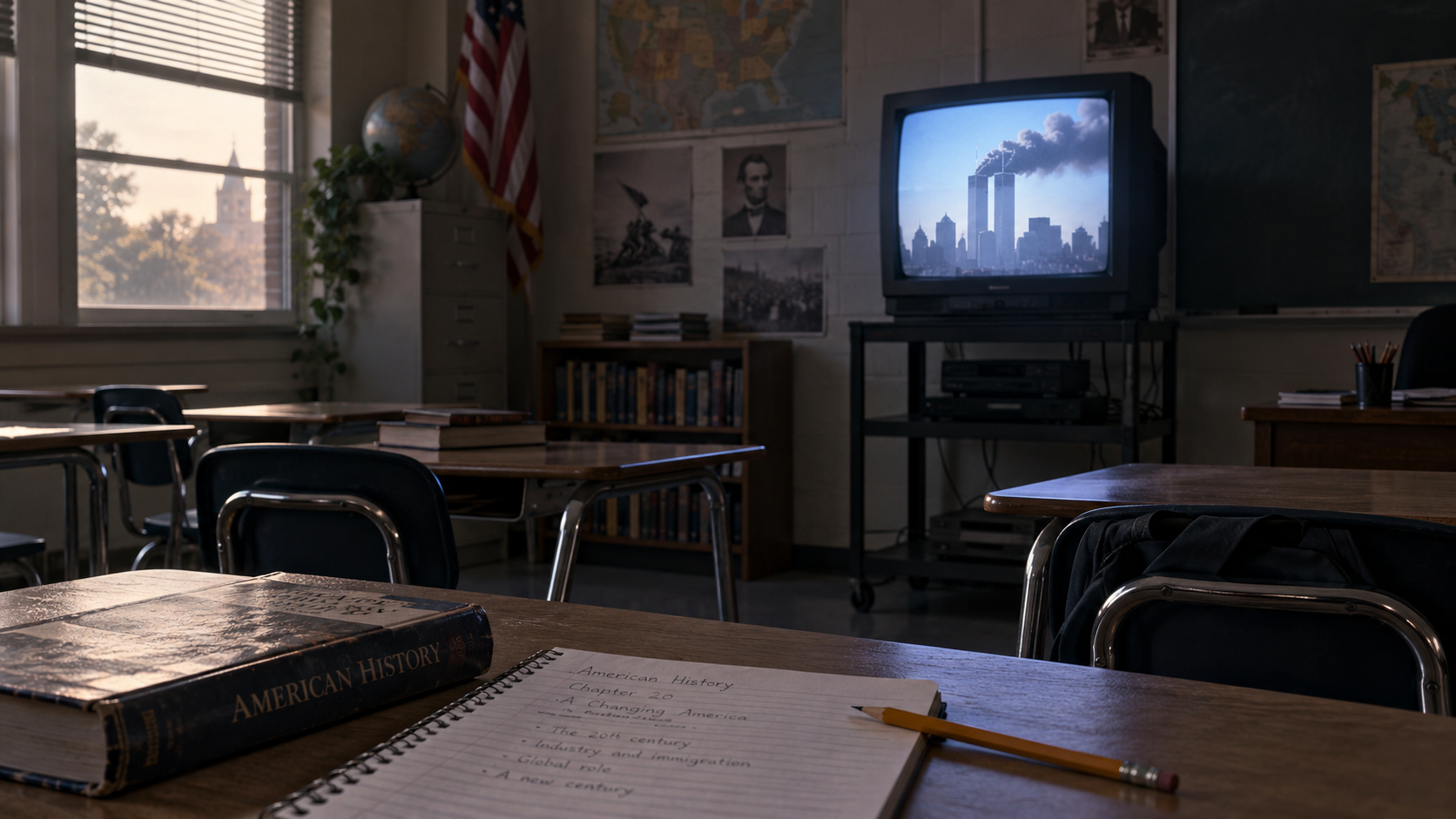
My September 11 remembrance begins in a place I would rather not remember at all. I was 14 years old and living in a group home in Columbia, South Carolina. We did school inside the home instead of attending public school, and that morning we were in American History class when the teacher turned on the television. That was how I learned the United States was under attack.
Some memories blur as the years pass, but this one never really has. I could not tell you what chapter we were supposed to cover that morning or what assignment came next. What I remember is the television coming on, the images on the screen, and the feeling that something much bigger than our classroom had just happened. We had been studying history, and suddenly the lesson had changed completely.
History Class Suddenly Became History
By the time we were watching the news, the country was already trying to understand what had happened. American Airlines Flight 11 had struck the North Tower of the World Trade Center, and United Airlines Flight 175 hit the South Tower soon after. American Airlines Flight 77 later struck the Pentagon, while United Airlines Flight 93 crashed in Pennsylvania after passengers and crew fought back against the hijackers.
Those facts are easy to organize now because we have had years to learn the timeline. At 14, I had none of that context. I only knew that smoke was pouring from the towers, adults were visibly shaken, and the news kept showing scenes that did not look real even though they clearly were.
The attacks killed 2,977 people across New York, the Pentagon, and Flight 93. That number matters because it shows the scale of what happened, but even that can become too abstract if we are not careful. Every one of those people had a life that was supposed to continue beyond that morning.
The Second Plane Changed Everything
One of the hardest parts of remembering September 11 is how quickly the meaning of the morning changed. After the first plane struck the North Tower, there was still confusion about whether it had been a terrible accident. Once the second plane hit the South Tower, that possibility disappeared.
The country was watching a coordinated terrorist attack unfold live on television. Nineteen al-Qaeda terrorists had hijacked four commercial airplanes and used them as weapons. None of that was clear all at once. The truth arrived piece by piece, and every new detail made the situation worse.
That is part of why the footage still feels different from many other historical events. We were not watching a documentary about something that had already ended. We were watching while nobody knew how many planes were involved, what the next target might be, or how much more would happen before the day was over.
The Loss Was Human
The Twin Towers became the most recognizable symbol of September 11, but the real loss was never about buildings. Nearly 3,000 people began that morning expecting an ordinary Tuesday. They went to work, boarded flights, made plans, and expected to return home later.
People were working inside the World Trade Center and the Pentagon. Passengers and crew members boarded four commercial flights. Firefighters, police officers, paramedics, and other first responders moved toward danger while thousands of people tried to escape it.
The numbers matter, but the people matter more. Each person who died had relationships, routines, plans, frustrations, favorite things, and people waiting for them. They were not simply part of a historical total.
Flight 93 Belongs in the Memory Too
The Twin Towers are usually the first image people picture when they think about September 11, but the attacks reached far beyond New York City. The Pentagon was also struck, and Flight 93 came down near Shanksville, Pennsylvania.
Passengers and crew aboard Flight 93 learned about the attacks happening elsewhere and fought back against the hijackers. They could not save themselves, but their actions prevented the plane from reaching its intended target.
Remembering September 11 means remembering all four planes and all three attack sites. New York is central to the story, but so are the Pentagon and that field in Pennsylvania.
The Country Felt Different Afterward
There is a clear before and after when I think about September 11. The world was not safe before that morning, and terrorism, war, violence, and tragedy obviously did not begin in 2001. Still, for many Americans, the attacks changed how close those threats felt to ordinary life.
Air travel changed, security changed, and government priorities shifted. The years that followed brought war, political arguments, new fears, and lasting changes in how the country thought about national security.
For those of us who were still growing up, September 11 became part of the background of adulthood. It was not just one terrible day. It shaped the world we moved into afterward.
What I Remember Most
What stays with me most is not the timeline. It is the feeling in that room.
I remember being in a place I hated and already feeling like I had very little control over my own life. Then suddenly the adults around me were watching something they could not control either. At 14, you still expect adults to know what comes next, even when you do not always trust them.
That morning, nobody seemed to know.
I remember the confusion more than anything else. There was no neat explanation yet, no finished story, and no sense of what would happen next. We were just watching something terrible unfold in real time.
Twenty-Five Years Later
This September 11 remembrance comes twenty-five years after the attacks, and that number still feels strange to me. An entire generation has grown up without remembering that morning at all.
Meanwhile, the memory still feels close. I can picture the classroom, the television, and the moment the lesson stopped being about the past. Some memories fade because life moves on. Others stay sharp because they mark a point where the world felt different afterward.
September 11 is one of those memories for me.
Remembering Means More Than Rewatching the Footage
Every year, the familiar images return. We see the smoke, the towers collapsing, the dust over Lower Manhattan, and first responders moving through scenes that still look impossible.
Those images matter, but remembrance should go deeper than replaying the worst moments. It means remembering the people who died and the families who continued without them. It means remembering the first responders who ran toward danger and the ordinary people who helped strangers in the middle of chaos.
The effects also did not end when the day ended. Survivors, families, and first responders carried the physical and emotional consequences forward for years. The story did not stop when the cameras moved on.
September 11 Became Part of Growing Up
For people who were children or teenagers in 2001, September 11 became tangled into the process of growing up. I was old enough to understand that people had died and that the attacks were intentional. I was still too young to understand all the political, military, and cultural consequences that would follow.
Over time, I learned the details I did not know that morning. I learned more about the victims, the first responders, the passengers of Flight 93, the hijackers, and the enormous investigation that followed.
That later knowledge never replaced the original memory. Underneath all the facts is still the feeling of sitting in that classroom and realizing that the lesson had stopped being about history and had become something we were living through.
Twenty-Five Years Later, I Still Remember
There are historical events we learn about, and there are historical events we remember living through. September 11 will always belong to the second category for me.
My September 11 remembrance starts with that classroom, but it is not only about where I was. It is about the people who died, the families who carried that loss forward, the first responders who ran toward danger, and everyone whose life changed that morning.
Twenty-five years later, I understand far more about what happened than I did then. I know the timeline, the flights, the scale of the loss, and the consequences that followed. None of that makes the memory feel less painful.
What I keep coming back to are the people. The people in the towers, the people at the Pentagon, the passengers and crew aboard the four flights, the first responders, and the families whose lives split into before September 11 and after it.
That is what I want this September 11 remembrance to hold onto most. Not only the fear of that morning, but the people who never got the chance to move beyond it.
Twenty-five years later, I still remember them.
0 thoughts on this story