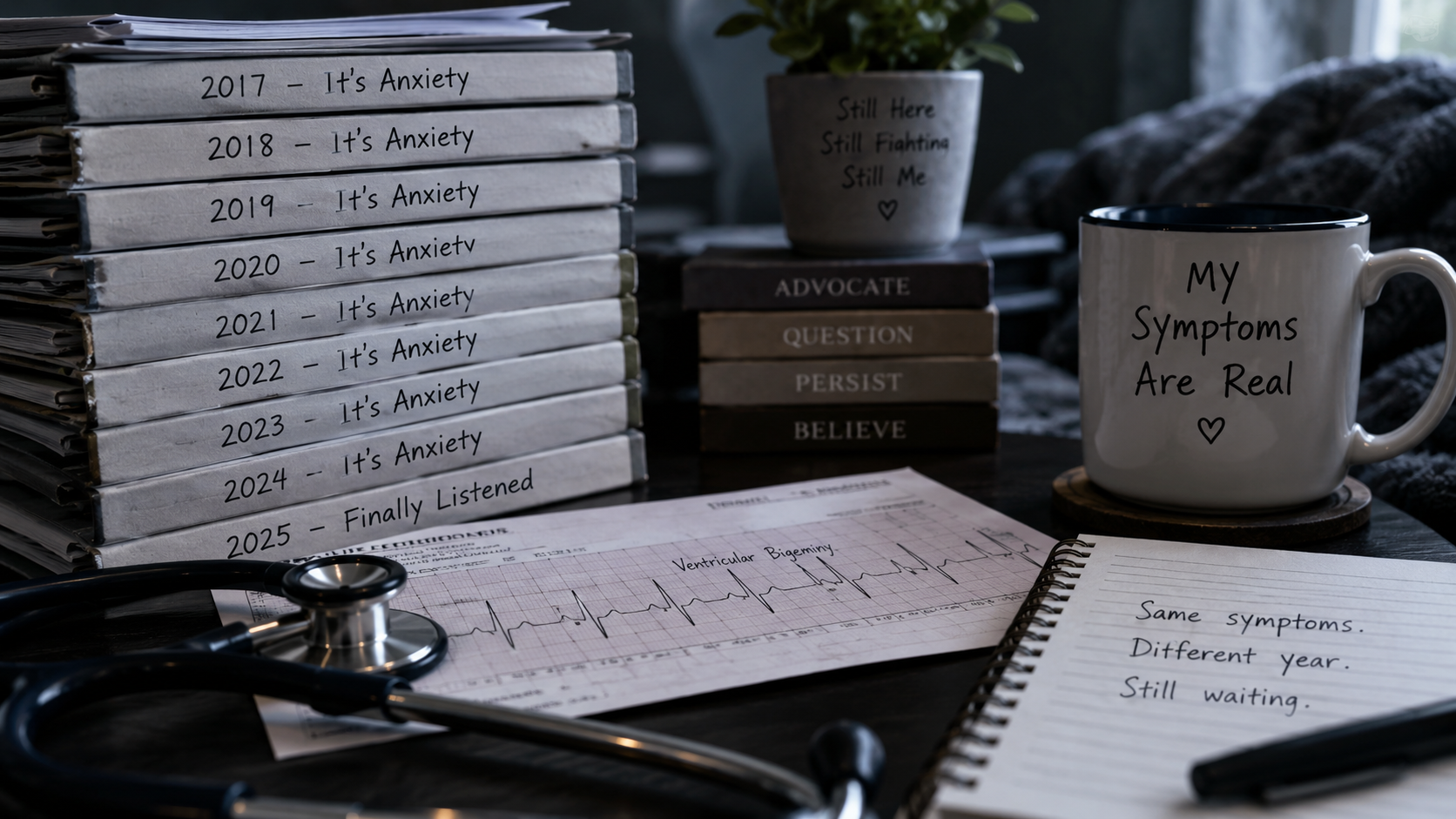
Medical trauma from being dismissed by doctors does not always come from one terrible hospital visit. Sometimes it builds slowly, appointment after appointment, every time you know something feels wrong and someone gives you an easier explanation. For me, that explanation was anxiety. From 2017 through 2025, I repeatedly dealt with heart symptoms while doctors kept pointing back to the anxiety diagnosis already sitting in my chart.
The difficult part is that I really do have anxiety. I have never needed anyone to convince me of that. The problem comes when a real diagnosis becomes a shortcut for explaining symptoms that deserve their own investigation. Once anxiety enters the conversation, it can become surprisingly difficult to get anyone to look past it.
Eventually, my heart problems stopped fitting comfortably inside that explanation. I now deal with actual cardiac conditions and rhythm problems, including sinus tachycardia, Sick Sinus Syndrome, atrial fibrillation, PVCs, and episodes of ventricular bigeminy. Looking back at those years changes the way I hear the phrase “probably anxiety” now.
My Medical History Was Already Complicated
My heart is not the only part of my medical history. I also live with chronic conditions that have sent me through more appointments, tests, specialists, and waiting rooms than I ever wanted to experience. CLL has been part of my life for years. Polycystic kidney disease and kidney stones added another specialty to the collection, while chronic migraines have created their own problems.
There are also gastrointestinal and respiratory issues in the mix, including a hiatal hernia and chronic bronchitis. None of these conditions makes me an expert in medicine. They have, however, made me very familiar with what it feels like to become a regular participant in the medical system.
That amount of medical care changes how you approach symptoms. You learn which things are normal for your body and which ones are not. You learn how to describe pain, how to answer the same questions repeatedly, and how long you can reasonably wait before deciding something needs attention.
You also learn how quickly a complicated history can work against you.
Anxiety Became the Answer Before Anyone Had the Answer
My cardiac symptoms started years before I finally had better explanations for what was happening. Beginning in 2017, I dealt with sinus tachycardia and symptoms that kept sending the conversation back toward anxiety.
For years, that explanation followed me.
Chest pain could be anxiety. A racing heart could be anxiety. Palpitations could be anxiety. Shortness of breath or dizziness could fit anxiety too. When you already have an anxiety diagnosis, almost anything involving your heart can apparently audition for the role.
Again, anxiety can cause very real physical symptoms. I know that firsthand. What became damaging was the assumption that anxiety explained everything before anyone could prove that it did.
There is a huge difference between a doctor saying, “Anxiety might contribute to this, but we should make sure nothing else is happening,” and treating anxiety like the end of the investigation.
For a long time, it felt much closer to the second version.
Eventually, There Were Names for What My Heart Was Doing
By 2025, the picture looked very different. Sick Sinus Syndrome entered my medical record. PVCs became a significant part of the conversation, and atrial fibrillation became part of my cardiac history too.
Those diagnoses did not erase my anxiety. They proved something much more important: anxiety was never a good enough reason to stop asking questions.
That realization comes with complicated emotions. There is relief in finally having evidence that something physical is happening. At the same time, there is anger when you think about how long you spent wondering whether you were overreacting.
Years of dismissal can teach you to doubt your own body.
You start asking yourself whether the pain is really bad enough. You wonder if the racing heart is something you should ignore. You question whether going to the hospital will help or simply lead to another expensive conversation about stress.
That kind of doubt does not disappear when you finally receive a diagnosis.
Medical Trauma Can Look Like Hesitating to Ask for Help
When I think about medical trauma, I do not only think about frightening procedures or emergencies. I think about what repeated dismissal changes afterward.
It changes the calculation behind seeking care.
Instead of simply asking, “Do I need medical attention?” another question appears beside it: “Are they going to believe me?”
That is an awful question to have running through your head when you already feel sick.
You begin preparing your case before you ever reach the hospital. You remember which diagnoses you need to mention, which medications you take, what your heart rate did, how long the pain lasted, and which symptoms might make someone take the situation seriously. Medical care starts feeling less like asking for help and more like arriving prepared for cross-examination.
That is exhausting before anyone has even taken your blood pressure.
Then My Heart Went Into Ventricular Bigeminy
That history is part of why my recent hospital stay has been difficult to shake.
I was in the hospital from September 1 into September 2. During that visit, I went into ventricular bigeminy, meaning the monitor showed a repeating pattern involving normal beats and premature ventricular contractions.
For me, that was not an abstract symptom I could explain away later. There was an EKG. There was hospital monitoring. The rhythm was happening while medical equipment watched it happen.
After spending years having heart symptoms tied back to anxiety, seeing something abnormal documented should make the situation feel simpler.
Instead, it created a new version of the same uncertainty.
I Emailed My Electrophysiologist as Soon as I Got Home
When I got home from the hospital, I emailed my electrophysiologist. I asked him to review the hospital EKG and monitoring because I wanted him to see the ventricular bigeminy.
I was not asking him to take my word for what my heart felt like. I was pointing him toward actual cardiac data from a hospital visit.
Then I waited.
Now it is September 11, and I still have not heard from him about it. We are well beyond two business days. Every additional day of silence bothers me more because this is exactly the kind of situation where my history makes waiting difficult.
I do not need an instant solution. I would like acknowledgment that somebody responsible for managing my heart has looked at what happened.
There is an enormous difference between those two things.
I Am Still Waiting for the Holter Results Too
At the same time, I am waiting for the results from my Holter monitor. More than a week has passed, and I still do not have those results either.
Waiting for medical results is a strange kind of limbo. You already did your part. You wore the monitor, dealt with the inconvenience, and returned it. After that, the information exists somewhere, but you do not have it yet.
When you have a history of cardiac symptoms being minimized, silence does not feel neutral.
It leaves room for every old experience to come back.
Was something important recorded? Has anyone reviewed it? Did the hospital rhythm show up there too? Does my doctor consider this significant? Am I supposed to keep waiting, or am I supposed to contact the office again?
A person without my medical history might experience the delay as ordinary medical bureaucracy. Maybe that is all it is.
My brain does not have the luxury of experiencing it that way.
“No News” Does Not Feel Reassuring Anymore
People sometimes say that no news is good news when it comes to medical testing. I understand what they mean, but I cannot make myself believe it.
Silence is not an explanation.
After years of having symptoms blamed on anxiety, I need communication more than I used to. If something looks fine, I want someone to tell me it looks fine. If something needs follow-up, I want to know what comes next. If a specialist reviewed an abnormal hospital EKG and does not think it changes the plan, I still want to know that someone actually reviewed it.
Without that communication, I am left trying to decide what silence means.
That is exactly the kind of uncertainty medical trauma feeds on.
Being Proven Right Does Not Feel Like Winning
There is a temptation to look at later diagnoses and think they somehow vindicate all those earlier years. In one sense, they do. Something physical really was happening with my heart.
It does not feel satisfying.
I would much rather have been wrong.
I would rather every episode had been anxiety. Anxiety is miserable, but I already knew how to live with it. I did not spend years hoping someone would eventually find something wrong with my heart just so I could say I told you so.
What I wanted was for someone to take the symptoms seriously enough to find out.
That difference matters.
Being medically dismissed creates a strange situation where receiving a diagnosis can bring relief and grief at the same time. You finally have an answer, but the answer also confirms that questioning yourself for years was never necessary.
Anxiety and Physical Illness Can Exist at the Same Time
One of the most frustrating things about this experience is the false choice between anxiety and physical illness.
I can have both.
Anxiety does not protect me from heart problems. A heart condition does not erase anxiety. One diagnosis does not automatically explain every symptom that happens afterward.
Medicine should be able to hold more than one idea at a time.
Sometimes anxiety probably does make my heart symptoms feel worse. Sometimes heart symptoms trigger anxiety because feeling your heart behave strangely is, as it turns out, not especially calming. That relationship can go in both directions without making either problem imaginary.
The danger comes when anxiety becomes a reason not to look deeper.
I spent too many years learning what that feels like.
My Trust in Medicine Is Complicated Now
I still go to doctors. I still get tests, take medications, see specialists, and follow up when something concerns me. Medical trauma has not made me reject medicine.
It has made trusting the process harder.
I notice delays. I worry when messages go unanswered. I pay attention when a symptom gets blamed on something before anyone has ruled out other possibilities. When someone reassures me, part of my brain wants to know exactly what evidence supports that reassurance.
That may sound exhausting because it is.
I do not want every medical interaction to feel like I need to stay on guard. I would love to hand over the problem, trust that someone will investigate it, and wait calmly for the answer.
My experiences have not taught me to do that.
They taught me that sometimes I have to keep asking.
I Am Tired of Having to Prove That My Body Is Doing Something
The current situation with my electrophysiologist has brought a lot of this back to the surface. I had an abnormal rhythm documented in the hospital, contacted the specialist who manages that part of my care, and I am still waiting to hear what he thinks.
Maybe there is a completely ordinary explanation for the delay. Medical offices are busy. Doctors have other patients, messages pile up, and monitor reports do not always appear instantly.
I understand all of that.
Understanding the system does not erase what waiting feels like after eight years of being told anxiety could explain what my heart was doing.
That is the part of medical trauma people do not always see. It is not only fear of hospitals, needles, scans, or bad news. Sometimes it is the fear that something is wrong and the people you need to notice it will not.
I have spent years learning how to push through symptoms, explain myself clearly, keep track of tests, and advocate for answers. I am tired of feeling like evidence has to become overwhelming before I am allowed to trust what my own body has been telling me.
I do not expect medicine to have every answer immediately. I do expect my concerns to matter.
After everything that has happened, being taken seriously should not feel like such a difficult thing to ask for.
0 thoughts on this story