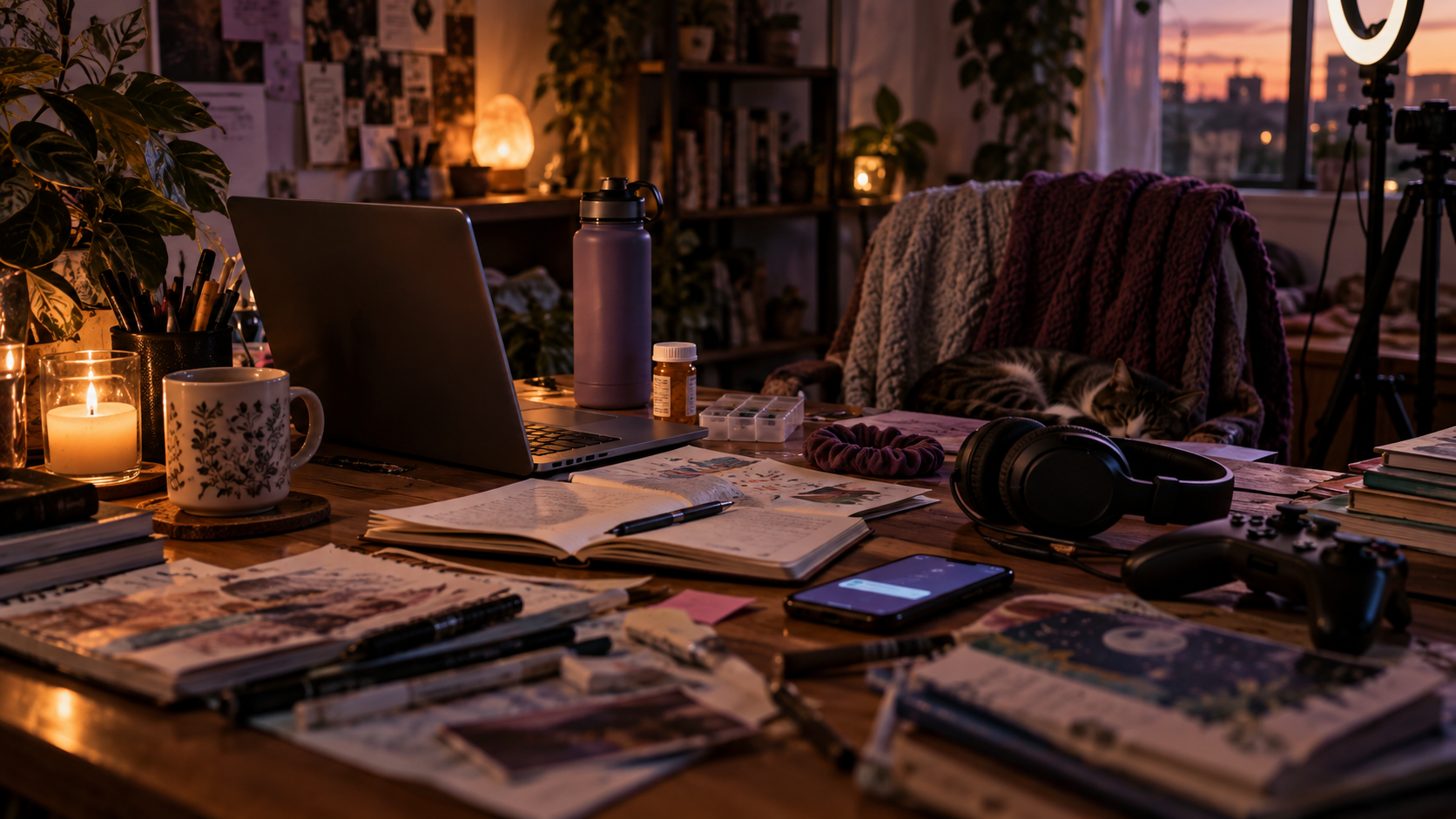
I am tired of every hobby needing to become content. Somewhere along the way, it stopped being enough to enjoy making something. If you write, you should publish it. If you draw, you should sell prints. If you game, you should stream. If you make something interesting, you should film the process, edit the video, post it on three platforms, and somehow convince an algorithm that your afternoon deserves distribution.
I understand why people do it because I do it too. In my case, the pressure is not only coming from social media or some vague need to be productive. I cannot work a normal job right now, so the things I know how to create sometimes start looking less like hobbies and more like possible income. That changes the question from, “Would this be fun?” to, “Could I make money doing this?” much faster than I would like. Unfortunately, chronic illness does not become more cooperative just because I have identified a possible revenue stream.
The Internet Has Monetized Having Interests
There has always been a way to make money from creative skills. Writers sold books long before Instagram existed, artists took commissions, musicians played gigs, and people turned things they loved into careers. The difference now is how quickly the expectation appears. You can barely mention enjoying something before someone suggests turning it into a business.
Like baking? Sell it. Good at organizing? Make printables. Know something useful? Build a course. Enjoy gaming? Stream it. Write for fun? Start a newsletter, publish a book, launch a membership, make videos about writing the book, and apparently become a small media company somewhere between chapters three and four.
Sometimes those suggestions are genuinely useful. There are people who have built careers that way, and I understand the appeal of earning money from something you already love. The problem starts when every interest begins to feel unfinished until it produces something measurable. A hobby used to be allowed to exist because you liked it, but now liking it can feel like only step one of the business plan.
For Me, the Money Part Is Complicated
It would be easy to write this as an essay about refusing hustle culture and reclaiming hobbies for joy. That would also leave out a pretty important part of my reality. I would like to make money, and there is nothing shameful or unusual about that.
Bills continue their deeply committed relationship with arriving every month. Traditional employment is difficult for me because of my health, so flexible income from home could make a real difference. That means my creative skills sometimes feel valuable in two completely different ways at the same time.
Writing matters because I love writing, but it might also become income. Designing something can be enjoyable, but maybe I could sell it. A creative idea can start as something interesting and almost immediately become a question about whether it has an audience. There is nothing inherently wrong with that, but possibility can turn into pressure very quickly.
Chronic Illness Makes Consistency Complicated
Most advice about making money online eventually reaches the same word: consistency. Post consistently. Publish consistently. Build consistently. Show up consistently. Keep producing even when the numbers are disappointing because growth takes time.
That sounds reasonable until your body considers consistency more of a creative suggestion. Chronic illness can make the amount of energy available from one day to the next wildly uneven. I can have ideas on a day when I do not have the energy to execute them, and on another day I might finally feel capable of creating something while every other responsibility is already waiting.
School, appointments, household tasks, and everything that got pushed aside during a worse day still need attention. Then there are the days when doing the minimum is the entire assignment. Those days do not care about content calendars, posting schedules, unfinished drafts, or whether I was supposed to upload something at the statistically ideal time.
The internet rewards consistency, while chronic illness often requires flexibility. Trying to live between those two systems can feel like having two managers who have never spoken to each other and somehow both expect immediate results.
Making the Thing Is Only the Beginning
One reason monetizing hobbies sounds easier than it actually is comes down to how much invisible work sits around the hobby itself. Writing something is one task, but publishing it is several more. There is editing, formatting, SEO, images, social media, promotion, website maintenance, analytics, and whatever new platform feature someone insists you absolutely need to understand this week.
The same thing happens with almost any creative hobby. Making the product is only part of selling the product. Creating the video is only part of running the channel. Writing the book is only part of being an author, and making something beautiful is only part of convincing other people to notice it.
Suddenly, the hobby that once gave you somewhere to escape has developed administrative duties. That does not mean I hate those parts because some of them are interesting, and I genuinely enjoy building things. Still, there is a difference between choosing to learn something because it sounds fun and discovering your relaxing creative project has quietly promoted you to marketing department.
Even Relaxing Starts to Feel Suspicious
Once you get used to thinking this way, it becomes difficult to switch off. I can be enjoying something and suddenly catch myself evaluating it. Could this become a post? Is there an article in this? Should I take a picture? Would anyone watch this? Could this idea become something I could sell?
Those questions are not always unwelcome because I am a creative person and ideas naturally connect to other ideas. Sometimes something ordinary genuinely does inspire a piece of writing or a project I am excited to make. The difference is whether the idea feels exciting or obligatory.
When everything becomes potential content, experiences can start feeling like raw material. Instead of simply doing something, part of your brain stands nearby taking notes. A hobby stops being a place where you spend time and starts becoming something you need to extract value from. Eventually, even relaxing can begin to feel like a missed opportunity.
Making Money From Something You Love Is Still Complicated
There is another uncomfortable part of this conversation. Saying that monetizing something you love can make it harder to enjoy sometimes sounds ridiculous when so many people work jobs they hate because they need money. Plenty of people would love the chance to make an income from writing, art, games, music, or any other creative interest.
I understand that completely, and I also think both things can be true. Getting paid for something you enjoy can be wonderful. Depending on something you enjoy to help support you can also change your relationship with it.
Once money enters the picture, there are deadlines, expectations, customers, audiences, algorithms, sales numbers, and financial stakes that were not there before. The hobby may still be something you love, but now it has more weight attached to it. That weight can become especially heavy when you need the income but cannot always produce on demand.
The Numbers Can Make It Worse
Creative work online comes with an unsettling amount of measurement. Views, clicks, likes, followers, subscribers, sales, watch time, engagement, reach, and several other numbers are ready to tell you exactly how many people ignored the thing you spent hours making.
Numbers can be useful because if you are trying to build something, you need some idea of what works and what does not. The problem comes when the numbers begin deciding whether the time itself was worthwhile. A post can be meaningful even if few people read it, and a book can matter before it sells a certain number of copies.
A piece of art can be worth making even when nobody buys it. A game can still be fun when there was no camera recording the experience. Those things become harder to remember when every platform provides a dashboard ready to grade your hobbies. Nothing says relaxation quite like receiving performance analytics afterward.
I Am Still Trying to Make Some of This Work
Despite everything I just said, I am not planning to stop trying to earn money creatively. That would not be truthful, and it would ignore the fact that flexible work may be one of the few realistic options available to me.
I write. I build websites. I design things. I have published books, started projects, created content, and spent a lot of time trying to figure out what I can realistically build around the life and health I actually have. Some of those things may eventually become dependable income, and I hope they do.
The difference I am trying to create is between choosing which hobbies become work and assuming that all of them should. Maybe some ideas deserve business plans. Others might deserve nothing more than a few enjoyable hours. I should be able to write something without publishing it, play something without turning it into content, or learn something new without immediately researching whether there is a market for it.
Not every interest needs to justify the time I spend on it, especially when so much of my time is already being measured against what I can physically manage.
Making Money From Home Is Still Work
There is a myth buried in a lot of advice about earning money through hobbies. The idea is that if you love doing something, making money from it will somehow feel easier than having a job. Sometimes it probably does because it can offer flexibility, control, and the ability to build something around your own life.
Those benefits matter enormously when a traditional work schedule is difficult or impossible. However, flexible does not mean effortless. Running a creative business from home still requires energy, and content creation still requires energy.
Marketing takes energy too. So do answering messages, fixing technical problems, planning projects, promoting work, and figuring out why something that worked yesterday has mysteriously stopped working. Chronic illness does not care that the work happens from my couch.
That has been one of the harder things for me to accept. Flexible work may fit my life better, but a job I create for myself still has to fit inside the same body that made a normal job difficult in the first place.
I Need Some Things to Stay Mine
Maybe that is why I have started feeling protective of hobbies that do not accomplish anything. There needs to be room for interests that are not trying to save me financially. They do not need to become brands, income streams, portfolio pieces, networking opportunities, or proof that I used my free time wisely.
Some things should be allowed to exist because they make an otherwise difficult day a little better. That does not mean I am giving up on making money from creative work. I am still going to try because I want more financial independence, and I need work that can bend around the realities of my health.
I just do not want every thing I love to carry that responsibility. There is too much pressure in needing every creative idea to work, especially when failure starts to feel less like a failed project and more like a failed attempt at finding a workable future.
A Hobby Does Not Have to Earn Its Keep
I think that is the boundary I am still learning to build. Some creative work can be work. Some hobbies can become income, and some projects can be built with an audience or business in mind.
The rest should be allowed to stay hobbies. They can be inconsistent, pointless, unfinished, or completely private. I can be bad at them, change my mind about them, or enjoy them without becoming good enough to teach anyone else.
Most importantly, they do not have to earn enough money to prove they deserved my time. When chronic illness already forces me to think carefully about where my limited energy goes, I do not want every enjoyable thing to become another calculation.
Some of my creativity may need to help me build a future, and I genuinely hope it does. I just need some of it to remain a place where I can live in the present.
0 thoughts on this story