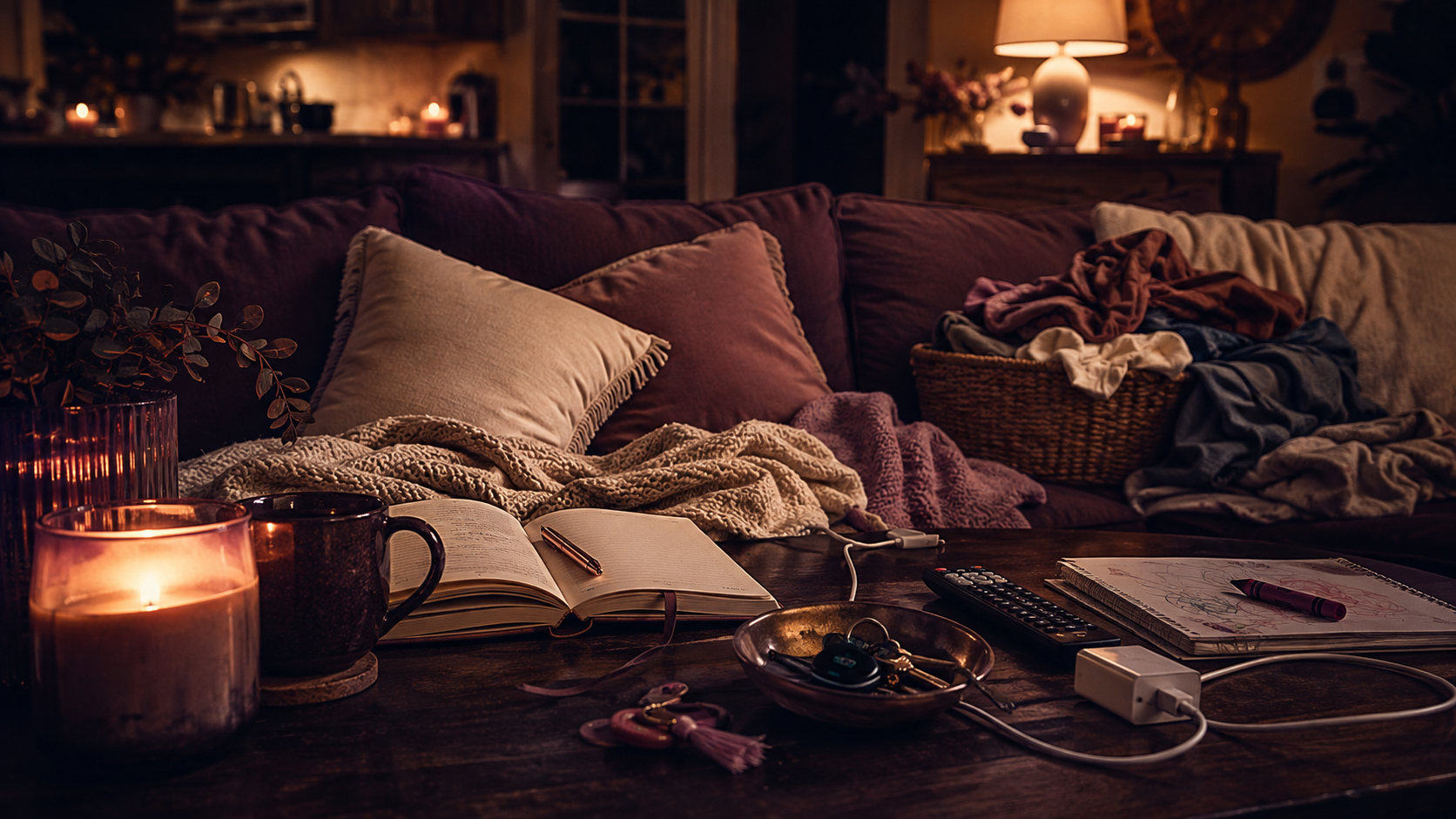
There is a version of realistic self-care that exists almost entirely on the internet. In that version, you light a candle, take a long bath, put on a face mask, journal for twenty minutes, drink something aesthetically pleasing, and emerge calmer, better rested, and somehow in possession of clearer skin. I fully support that version of self-care and whatever peaceful household makes it possible. I just do not know her personally.
In my house, self-care looks less like a luxury retreat and more like finding ten minutes where nobody needs me. Sometimes it means finishing a shower without answering a question through the bathroom door. Other times, it means playing a game after everyone settles down, writing when the house finally gets quiet, or deciding that the laundry can survive one more night in the basket without creating a family emergency. At this point, I am convinced those things count just as much.
For a lot of people, that is probably closer to reality anyway. Self-care is not always candles, spa music, and a drink arranged beside a perfectly folded towel. Sometimes it is reaching a point in the day where nobody is actively asking you to locate, solve, schedule, explain, fix, remember, or emotionally manage something for five uninterrupted minutes.
Somehow I Became the Household Search Engine
One of the stranger parts of family life is realizing how much information can end up living in your head. You know who has an appointment, which school assignment still needs attention, what needs to be bought, what is running low, which password belongs to which school platform, and what absolutely cannot be forgotten tomorrow. You may also know where half the household’s belongings are, even when you had nothing to do with putting them there.
Then somebody asks where their shoes are.
The shoes are by the door. They are usually by the door. Yet somehow their location becomes classified information until I am called in to investigate.
The questions rarely stop at shoes. Where is the charger? Have you seen my socks? Where is the remote? Where is the cereal? Did you see the thing I was holding approximately four minutes ago? At some point, I apparently became the household search engine despite having no memory of applying for the position.
The exhausting part is not answering one question. It is the fact that your brain stays on call all day. Even when nobody is actively asking for something, part of you is still tracking what needs to happen next.
“Make Time for Yourself” Sounds Lovely on Paper
People love saying, “You have to make time for yourself,” as though unused time is sitting in a drawer somewhere and I simply forgot to claim it.
Sometimes there really is room in the day that I could protect better. Other times, the schedule already contains online school, household work, meals, errands, messages, appointments, family needs, my own needs, and whatever random problem shows up without warning. Several necessary things are fighting over the same twenty-four hours, and none of them seem willing to resign.
That is why “just make time” can feel almost insulting in its simplicity. The problem is not always bad planning. Sometimes there simply is not much empty space left.
I still believe time for yourself matters. I just stopped believing it only counts if I can clear an entire afternoon. If a three-hour wellness routine were required, I might finally achieve self-care sometime around retirement.
Assuming the laundry has not taken me out first.
Self-Care Got Smaller, and Somehow More Useful
I used to think self-care needed to feel substantial. It should involve enough time, effort, or planning to deserve the name.
Now I think some of the most useful versions are almost embarrassingly ordinary. A shower without rushing counts. Sitting somewhere quiet counts. Writing because my brain refuses to stop carrying a thought counts. Playing a game because I enjoy it counts too, especially if I manage not to turn it into another project.
Going to bed instead of squeezing one more task into the night definitely counts, even though I am particularly talented at ignoring that one. There is always one more thing I could do, and adulthood has a magical way of making that one thing reproduce into six more things while I am looking at it.
Sometimes the healthiest choice is deciding I have done enough for the day. The dishes will still exist tomorrow. The laundry has already shown incredible long-term survival skills. Neither needs me to sacrifice my last functioning brain cell tonight.
The Mental Load Does Not Stop When I Sit Down
Physical rest and mental rest are not always the same thing.
I can sit on the couch and immediately start planning tomorrow’s schoolwork, remembering something I forgot to order, thinking about an appointment, or wondering whether I answered a message. I may look like I am resting, but mentally I am running a staff meeting with no employees and an alarmingly long agenda.
A lot of mental work is invisible because people see the result rather than the thinking behind it. They see that the appointment happened, not that someone remembered to schedule it. They see that the school assignment got done, not the hundred tiny steps required to get there.
That is also why interruptions can feel much bigger than they look. When my brain finally settles into writing, gaming, reading, or doing absolutely nothing, being interrupted can feel like somebody shut down a program that took twenty minutes to load.
There is no autosave for peace.
Rest Should Not Be a Prize for Finishing Everything
Somewhere along the way, I started treating rest like something I had to earn. Finish the work, handle the house, take care of everyone, complete the list, and then maybe sit down.
The obvious problem is that the list never ends.
There will always be another load of laundry, another message, another school task, another room that could use attention, or another project that could move forward. If rest only becomes acceptable when everything is finished, rest becomes permanently unavailable.
That is a terrible system, and I am trying to unlearn it.
I am getting better at thinking of rest as maintenance instead of a reward. Phones need charging. Cars need fuel. Computers need updates. Apparently human beings also require basic care despite years of personal evidence suggesting I would prefer to operate indefinitely on anxiety, stubbornness, and whatever energy happens to remain.
Being exhausted is not proof that I worked hard enough. Sometimes it is proof that I should have stopped before my body started filing formal complaints.
Guilt Can Ruin a Break Faster Than Any Interruption
Even when I do stop, guilt sometimes follows me into the break.
I could work on the website. I could clean something. I could write. I could answer a message. I could prepare tomorrow’s schoolwork. I could start another project because apparently I enjoy making my own life harder in highly creative ways.
My brain can turn twenty minutes of rest into twenty minutes of listing everything I should be doing instead. It is impressively efficient and completely useless.
The truth is that pushing through exhaustion rarely gives me better work. Usually, I become slower, less patient, and more irritated because my body continues behaving like a human body instead of an industrial machine.
There is no trophy for reaching burnout first. Nobody appears with balloons and says, “Congratulations, you successfully ignored every warning sign.”
If that ceremony exists, I would prefer not to qualify.
Being Needed Is Not the Same as Disappearing
Family life takes up a huge amount of space, and that is not automatically a bad thing. I love the people in my life. I also need to exist as something other than the person who manages school, appointments, schedules, meals, passwords, missing objects, and everyone else’s needs.
That is part of why writing, gaming, designing, learning, and creating matter so much to me. Those things are not pointless extras I earn after every responsibility disappears. They remind me that I am still a person with interests, ideas, and things I enjoy.
I still want to create. I still want to write stories, play games, learn new skills, build things, and occasionally do something that serves no higher purpose beyond making me happy.
People are allowed to have interests that do not improve the house, grow a business, educate anyone, or produce something useful. Sometimes enjoyment can simply be enjoyment, which feels almost suspiciously rebellious in a culture determined to monetize every hobby.
Sometimes I Just Need Everyone to Stop Needing Me
I would happily accept a peaceful weekend where somebody else handled every responsibility. I am not morally opposed to luxury.
Most days, though, I do not need a spa retreat. I need fewer interruptions.
I want to finish a paragraph before somebody asks a question. I want to play a game without getting up every few minutes. I want to sit quietly long enough for my thoughts to stop arriving in random order. Mostly, I want to do one thing from beginning to end without also managing three other people’s needs.
That sounds small until uninterrupted time becomes rare. Ten genuinely peaceful minutes can feel more restful than an hour where I am technically taking time for myself while everyone still knows I am available.
Being physically present should not always mean being immediately accessible. That is something I am still learning how to practice.
Boundaries Do Not Have to Be Dramatic
When people talk about boundaries, it can sound like every one requires a serious conversation, dramatic music, and somebody storming out of a room.
Mine are usually far less exciting.
Sometimes it means saying, “Give me ten minutes.” Other times, I decide something is not an emergency just because someone wants it solved immediately. Occasionally, it means refusing to stand up and search for an object another fully capable person could probably locate by using their eyes.
That last one is harder than it sounds once everyone gets used to you knowing where everything is.
If I jump in every time someone cannot find something, I am not only exhausting myself. I am also teaching everyone that asking me is faster than looking.
I would like to retire from the household GPS position at least part-time. Applications for my replacement are open, and requirements include functioning eyesight and the ability to lift couch cushions independently.
Self-Care Is Usually Not Pretty Enough for Social Media
Some of the most useful forms of self-care are painfully boring.
Taking medication when you are supposed to counts. Eating when you realize you forgot counts. Going to sleep counts. Keeping an appointment counts. Canceling something because you genuinely cannot handle it also counts.
Sometimes taking care of yourself means admitting that your body is finished even though the list is not.
None of that makes especially glamorous content. There is no dreamy montage for taking medication on time, lying down because your body is done, or telling someone you cannot take on another thing today.
Maybe there should be.
I would absolutely watch a wellness account where someone simply said, “I canceled plans, ate something, took my medication, and went to bed before midnight.”
Ten out of ten. Aspirational content.
The least glamorous forms of self-care are often the ones that actually keep us functioning.
Chronic Illness Changes What Self-Care Means
When health problems are part of your life, self-care can stop looking optional very quickly.
There is a difference between feeling tired because the day was busy and starting the day with less energy than you wanted. If I use everything I have early, there may not be much left later. Ignoring that does not make the problem disappear. Sometimes it simply means I pay for it afterward.
Meanwhile, life continues.
Kids still need things. School still exists. Appointments still happen. Laundry continues multiplying quietly in dark corners despite my repeated objections.
That is why flexibility matters. Sometimes school moves. Sometimes a project waits. Sometimes I have to decide what truly needs to happen and let something else remain unfinished.
In those moments, rest is not laziness or indulgence. It is part of managing the life I actually have.
There is nothing luxurious about trying not to run yourself directly into the ground.
Letting Things Wait Is Still a Skill
I know the world will survive if the laundry sits overnight. Most messages can wait. A non-urgent task handled tomorrow will not bring down civilization.
Knowing that and behaving like I believe it are very different skills.
A part of me still wants to keep moving until everything feels finished. Unfortunately, adulthood produces tasks faster than I can remove them, which means that goal was impossible from the beginning.
So I am practicing stopping before everything is done.
A task can remain unfinished without becoming proof that I failed that day. An unanswered message can simply be a message for tomorrow. A basket of clothes can remain a basket of clothes instead of becoming a personal moral crisis.
Sometimes the laundry is just laundry. It does not need a character arc.
Maybe Self-Care Is Remembering That I Count Too
I am probably never going to become the person who wakes up at five in the morning to meditate before everyone else gets up. If I am voluntarily awake at five, something has gone terribly wrong.
What I do have is a growing awareness that I cannot keep treating myself as the least important person in my own life.
The kids matter. School matters. The house matters. Work matters. Appointments and responsibilities matter too, but none of them require me to pretend I am an unlimited resource.
Sometimes taking care of myself looks like writing or gaming. Other times, it means sleeping, being quiet, taking medication, eating something, or deciding not to be productive for a while. On especially advanced days, it means answering, “I don’t know where it is. Have you actually looked?”
The house will survive. The laundry will survive. Whoever misplaced the charger will almost certainly survive too.
And if I manage to get twenty peaceful minutes before somebody asks me where something is again, I am absolutely counting that as realistic self-care.
0 thoughts on this story