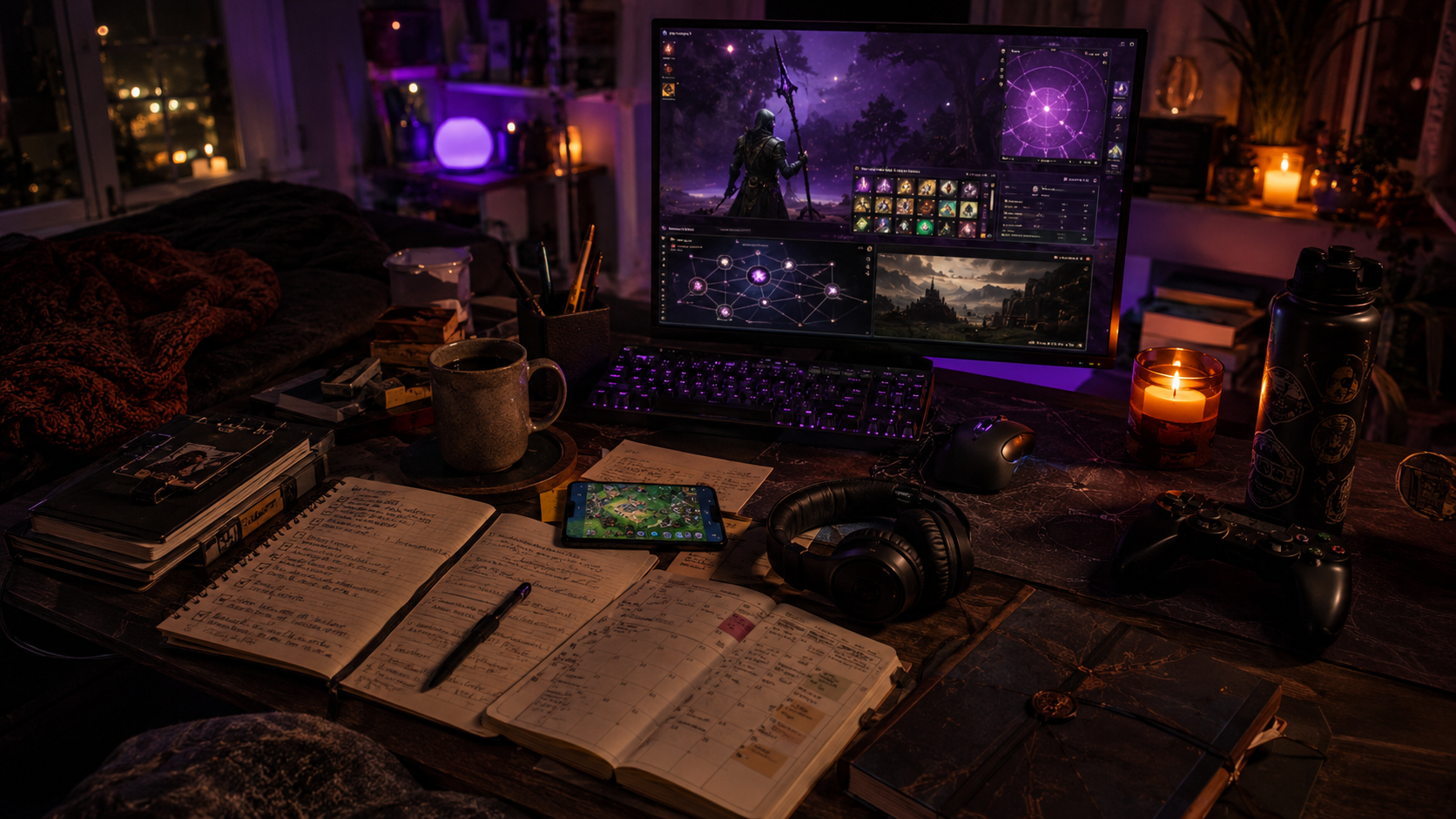
Gaming as an adult looks very different from the version of gaming I remember having time for. I still call myself a gamer, although that occasionally feels like a questionable claim considering how little I actually play lately. There are games installed on my computer that probably assume I died. Characters I once logged into constantly are likely standing exactly where I abandoned them, staring into the distance and wondering whether their player went out for cigarettes.
I did not stop loving games, which would actually make this much simpler. I still want to play them and still get excited about returning to something I love. My backlog also continues to exist under the deeply unrealistic assumption that I will eventually work through it. The interest never disappeared. Life simply placed a much larger obstacle course between me and the Play button.
Adulthood has a way of doing that. Things you once did without thinking suddenly require time, energy, and an odd amount of planning. Gaming now competes with parenting, online school, work, creative projects, household responsibilities, health, and the basic human need to occasionally sleep.
At this point, my free time has been acquired by a hostile corporation and divided among shareholders.
Gaming Used to Be Easier
There was a time when deciding to play a game involved roughly one step: deciding to play a game. I did not need to review tomorrow’s schedule first. Nobody required me to calculate whether two hours of gaming tonight would make the next morning unbearable.
These days, free time comes with negotiations. If I start playing now, how late will I stay awake? Will tomorrow be a heavy online-school day? Is there something else I should finish first? More importantly, am I awake enough to enjoy the game, or will I spend twenty minutes staring at my inventory without understanding anything on the screen?
Then there is the strange adult experience of finally getting free time and realizing you are too tired to use it. You spend all day waiting for the moment when nobody actively needs your attention. Once it arrives, you stare at the screen like an exhausted Victorian child who has just received troubling news about winter.
Apparently, freedom requires stamina.
Parenthood Changed My Time, Not My Interests
Becoming a parent changes your relationship with time in ways nobody fully explains. You still technically receive twenty-four hours every day. Several of those hours, however, now belong to people who occasionally ask questions they could answer by moving one object three inches to the left.
Parenthood did not erase everything I enjoyed before becoming a mom. Still, there is a strange expectation that certain interests should become less important when we reach Serious Adult Status. Gaming gets this treatment often, even though entire generations who grew up with video games are now adults.
We have jobs, bills, kids, health problems, rent or mortgages, aching joints, and strong opinions about fonts. We also still like video games. Receiving mail about retirement planning did not trigger a biological process that made Azeroth, survival games, strategy games, or multiplayer chaos less interesting.
My favorite will probably always be World of Warcraft. I return to it again and again, even after stretches where I barely have time to log in. There is something comforting about going back to a world I already know. Of course, I often return after a break to discover that everything changed, my bags are a disaster, and I have no idea what I was doing before I disappeared.
My Gaming Taste Has Never Been One Thing
WoW is only part of it. I also love 7 Days to Die, where surviving a zombie apocalypse somehow feels relaxing compared with managing real life. Stellaris lets me build civilizations and make galaxy-level decisions while I simultaneously forget why I walked into the kitchen.
Age of Empires scratches the strategy itch, while Heroes of the Storm gives me multiplayer chaos without requiring me to pretend I have patience. Other games fill whatever mood happens to show up that day.
Mall Simulator lets me build and manage something without anyone asking where their shoes are. Schedule 1 offers a completely different kind of management chaos. Dark War: Survival fills the mobile-game slot and still manages to produce enough alliance politics to make actual diplomacy look relaxing.
When I want something louder and faster, there is Call of Duty: Modern Warfare III on PS5.
That variety is part of why the gamer label still fits me. I do not have one genre that defines gaming for me. Some days I want progression or strategy. Other times I want survival, building, destruction, management, or simply a completely different set of problems for a while.
Real life could learn something from quest logs.
The Weird Guilt Around Pressing Play
Finding time is only half the problem. Sometimes the harder part is letting myself use that time for gaming once I finally have it.
There is always something else I could do. Laundry exists somewhere because laundry appears to reproduce when nobody is watching. Writing waits for attention, websites can always use another improvement, and something probably needs cleaning. Schoolwork may need checking, projects are unfinished, and adult life produces roughly nine thousand tiny administrative tasks.
Playing a game does not make any of those things disappear. It means I am choosing not to deal with them for a while. Productivity culture has done an impressive job of making that choice feel vaguely criminal.
Give an adult a free hour and apparently we should build a business, learn a skill, meal prep, exercise, organize a closet, and develop passive income. Ideally, we should emerge from that hour as a fully optimized version of ourselves.
Meanwhile, sometimes I just want to kill imaginary things.
Gaming does not need to create anything useful beyond the experience itself. I do not have to stream it, turn it into content, become amazing at it, or make those hours professionally productive. Sometimes I want to log in, play badly, accomplish nothing that improves my résumé, and leave happier than I started.
That seems like a perfectly reasonable return on investment.
I Notice When Gaming Disappears
When I go too long without gaming, I notice. It is difficult to explain that feeling to someone who sees games as nothing more than entertainment. I am not dramatically mourning a controller. Instead, I notice that another small part of myself has been pushed aside by responsibilities.
That happens easily when life enters survival mode. Parenting needs more attention. Health becomes complicated, work expands, or school requires more involvement. Something always moves to the front of the line, while gaming becomes something I promise myself I will return to when life calms down.
Unfortunately, life has repeatedly shown no interest in calming down.
I have stopped treating every stretch of reduced gaming as proof that I lost that part of myself. Playing less does not mean I stopped caring about it. My available time changed. Those are not the same thing.
Gaming as an Adult Comes With Office Hours
My gaming life looks different now. I cannot assume I can disappear into a game for an entire evening. Tomorrow also refuses to forgive the sleep-related crimes I once got away with.
There are more interruptions and fewer marathon sessions. I also experience the special joy of finally deciding to play something, only to discover that the game needs an update large enough to contain a small country.
When I do get to play, I still love it. Sometimes I return to World of Warcraft and remember why it has stayed my favorite. Other nights I build an empire in Stellaris, survive in 7 Days to Die, jump into Heroes of the Storm, or manage something ridiculous in Mall Simulator.
I might check in on Dark War: Survival or decide that my remaining energy should go toward getting shot repeatedly in Call of Duty. The game changes, but the reason I want that time stays pretty similar.
Gaming gives my brain something to focus on because it wants to focus on it. Even a chaotic game can feel like a break when the chaos has rules, goals, and some clear sign of whether I am winning.
Imagine the luxury.
Hobbies Do Not Need Constant Proof
I used to think identities required regular maintenance. If I was not writing enough, could I still call myself a writer? When I barely played anything for weeks, I wondered whether calling myself a gamer had started sounding like one of those hobbies people list in a bio despite not touching it since 2014.
I do not think that way anymore.
Different parts of us get more room during different seasons. Right now, motherhood and online school take up a huge part of my time. Health occasionally kicks down the door and demands control of the schedule. Writing, websites, creative projects, and everything else compete for whatever remains.
Sometimes gaming gets several hours. Other times, the controller sits untouched long enough to develop what feels like a judgmental layer of dust.
None of that changes the fact that I still love it.
Yes, I Still Count
I am a mom, a writer, a creative person, and someone trying to build things, learn things, survive things, and occasionally remember why I entered a room. I am also a gamer, even during the stretches when gaming has to wait its turn.
Maybe adulthood is not about outgrowing everything we loved before life became complicated. Instead, it may be about accepting that every part of us cannot receive the same amount of time at once. Something can move into the background without disappearing completely.
The games will still be there when I get back.
Unfortunately, so will the 84-gigabyte update.
0 thoughts on this story