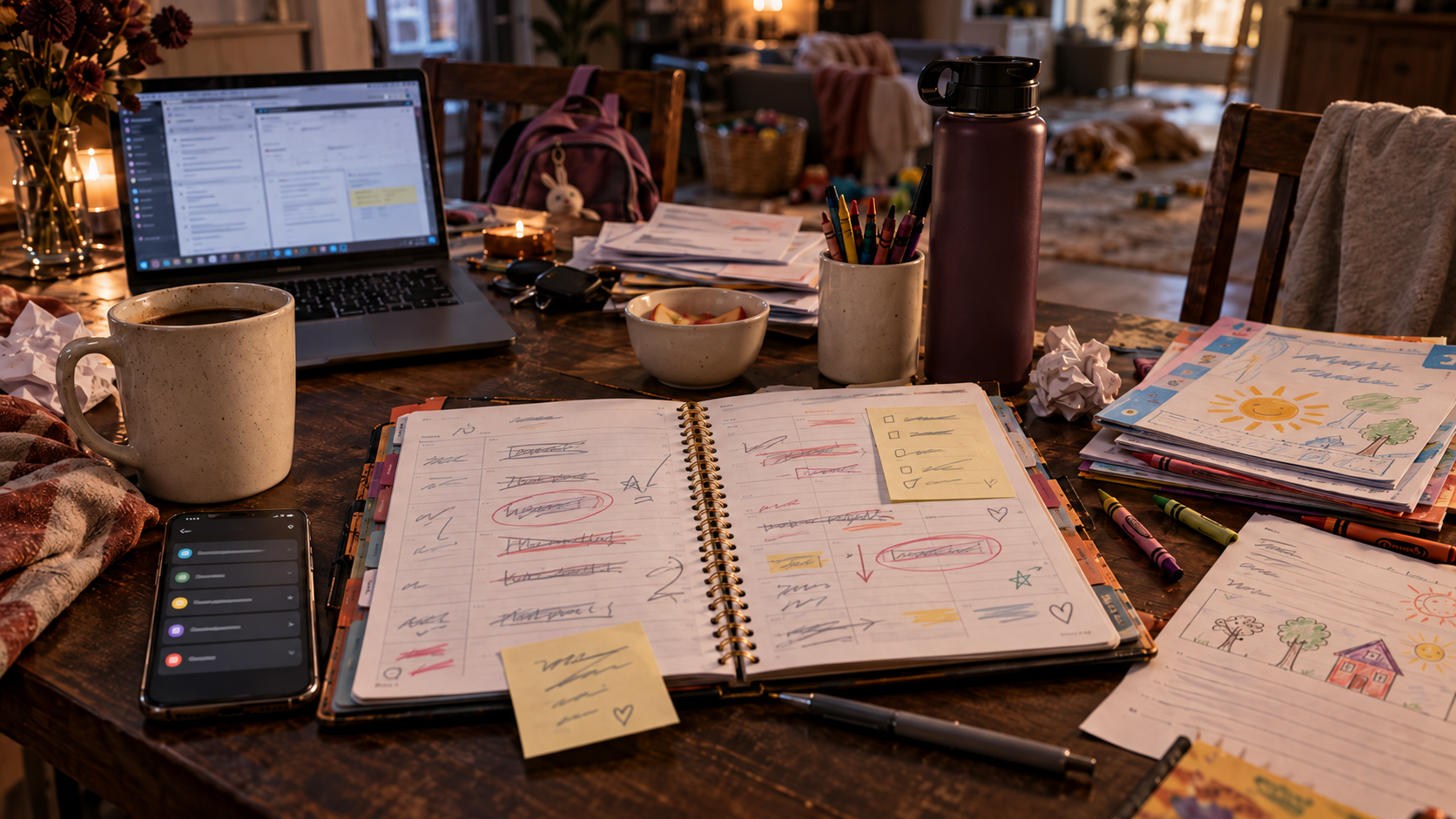
I keep making schedules as though I have learned absolutely nothing from my own life. Every week, I organize appointments, online school, errands, work, chores, and everything else into neat little blocks of time. I fully convince myself that this will finally be the week when trying to stick to a schedule works. The calendar looks reasonable, the timing makes sense, and there are even blank spaces that suggest I somehow have breathing room.
Usually, that illusion lasts until Tuesday. Sometimes Monday afternoon gets ambitious and ruins it early.
There is nothing technically wrong with the calendar. The appointments are real, the deadlines exist, and online school does begin at the time written down. My problem is that the calendar assumes nothing unexpected will happen between the start of the day and bedtime. At this point, that feels less like planning and more like fiction.
A child needs help with something that was supposed to be independent work. An assignment takes twice as long as expected. Someone cannot find the object sitting directly in front of them. Then I remember an errand about six minutes before the place closes. By the end of the day, the schedule I carefully created looks less like a plan and more like evidence from a failed experiment.
The Schedule I Made for Imaginary Me
The version of me who creates the schedule is extremely confident. She believes things will start on time and assumes tasks will take about as long as expected. Smooth transitions apparently happen in her universe too. Most importantly, nobody suddenly needs something the second she opens a laptop.
Calendar Me has ambition. Actual Me is standing in the kitchen trying to remember why I walked in there. Meanwhile, somebody needs help with school, another task is already ten minutes behind, and my phone is reminding me about something I scheduled during a temporary loss of judgment. Somehow, I still trust Calendar Me every single week.
I look at the upcoming days and think, This is manageable. There are open spaces, clean blocks of time, and entire hours with nothing written inside them. Unfortunately, I have learned that blank spaces are not always free time. Sometimes they are simply reserved for problems that have not introduced themselves yet.
Online School Does Not Respect Time Blocks
Online school has taught me that time is mostly theoretical. A live lesson may have a clear start and end time, but school does not always stop when the lesson ends. There can still be independent work, workbook pages, recorded responses, reading programs, math programs, phonics, and videos. All of it looks perfectly reasonable when it sits neatly on an assignment list.
Then we actually start doing it.
One activity takes ten minutes. Another turns into a forty-five-minute debate with a small person who has decided that writing one lowercase letter is deeply unfair. The live lesson may have gone well, but sometimes we still need to review part of it afterward. Hearing something explained in a virtual classroom and fully understanding it are not always the same thing.
That is when I become the follow-up teacher. I do not have a degree in early childhood education, so sometimes I end up Googling how to explain a concept I have understood for decades. Nothing humbles you quite like trying to explain kindergarten work clearly. It is even better when your first three explanations somehow make the situation worse.
The block on the calendar may say school ends at a certain time, but school itself tends to linger. It expands into nearby tasks and starts eyeing lunch like it has plans for that too.
Everything Takes Longer Than It Says
Scheduling depends heavily on the idea that activities have predictable lengths. Real life seems personally offended by that idea.
A quick phone call can take twenty minutes because of hold music and multiple transfers. A ten-minute errand can become an hour because of traffic or a long checkout line. Sometimes the item I came for has also been moved to a location known only to three employees and an ancient prophecy.
Doctor appointments belong in their own category. The calendar may say 1:00 p.m., but that leaves several questions unanswered. Does that mean I see the doctor at 1:00? Am I checking in at 1:00? Or am I sitting in a waiting room at 1:00 while a television near the ceiling plays a home renovation show with subtitles?
The calendar does not know. It simply says 1:00, which feels dangerously hopeful.
Even ordinary household tasks refuse to follow neat estimates. Laundry sounds simple when you describe it as washing, drying, and putting clothes away. In practice, it has become an ongoing household ecosystem. It does not really begin or end. It just changes form and moves somewhere else.
Then Come the Side Quests
Every day seems to have at least one side quest nobody planned. Sometimes it is small. Someone needs something printed, a password stops working, or we are out of something I could have sworn we had yesterday. A device may also refuse to connect to the internet while sitting close enough to the router to form a personal bond with it.
Other times, the side quest develops layers. One small problem creates another, which leads to an errand and delays something else. Tomorrow’s schedule shifts, and suddenly I am moving three things around. Tuesday got into a fight with Monday, and somehow Wednesday is paying for it.
This is how calendars become fiction. The original plan may have been completely reasonable. It simply existed before reality submitted its edits. Reality has no respect for deadlines and a deeply questionable sense of pacing.
I Actually Like Having a Plan
The frustrating part is that I genuinely like having a plan. I do better when I know what needs to happen. Lists, calendars, and reminders keep everything from floating around in my brain at the same time. Without them, an important task may disappear into the same mental void where I occasionally put my phone while actively looking for it.
Planning gives the day structure. It also shows me when I am trying to squeeze four hours of responsibilities into ninety minutes. That is useful information, even when I decide to attempt it anyway. The problem is not planning. It is expecting the plan to survive untouched.
For a long time, I treated changes like proof that I had done something wrong. Not finishing everything meant I had failed at time management. Moving something to tomorrow meant I was behind. When the day went sideways, I felt like I had to cram even more into the remaining hours.
That mindset turns normal problems into a personal performance review. It also assumes time management is the only thing affecting the schedule. It is not. Children, health, appointments, energy levels, and technology all have opinions about how the day should go.
Responsibilities appear without warning. Other people need things. Some tasks become more complicated once you actually start them. A calendar can help organize all of that, but it cannot control it.
I Am Learning to Leave Room for Reality
Lately, I have been trying to build more room into the day. I do not mean huge amounts of empty time. I have not suddenly become a mysterious wealthy person with a personal assistant and nowhere to be. Instead, I mean small buffers, fewer back-to-back tasks, and more realistic estimates.
I am also trying to accept that online school may spill over. An appointment might take half the day. An errand could take longer than expected. None of those things automatically mean the whole day is ruined.
More importantly, I am working on not treating every schedule change like an emergency. If something moves to tomorrow, the world usually continues. Laundry can wait without causing the fall of civilization. An errand getting pushed back because school ran long does not mean I failed at adulthood.
Some deadlines still matter. Appointments still have times, kids still need structure, and certain things cannot be moved. The difference is that not everything is equally urgent, even when my brain tries to convince me otherwise.
That distinction has helped more than any perfect planner ever could.
The Calendar Is a Draft
I still use a calendar, make lists, set reminders, and plan the week. Somehow, I continue doing this with the confidence of a person who has forgotten every week that came before it. The difference is that I am starting to see the schedule as a draft instead of a contract.
It tells me what I hope will happen and helps me decide what matters most. The plan gives the chaos some structure, but then real life gets a vote. Sometimes the day follows the schedule beautifully. Other times, a school block runs long, an appointment is delayed, dinner becomes whatever requires the fewest decisions, and Tuesday’s task quietly moves to Thursday.
That does not always mean the schedule failed. Sometimes it simply means the schedule met reality, and reality had notes.
0 thoughts on this story