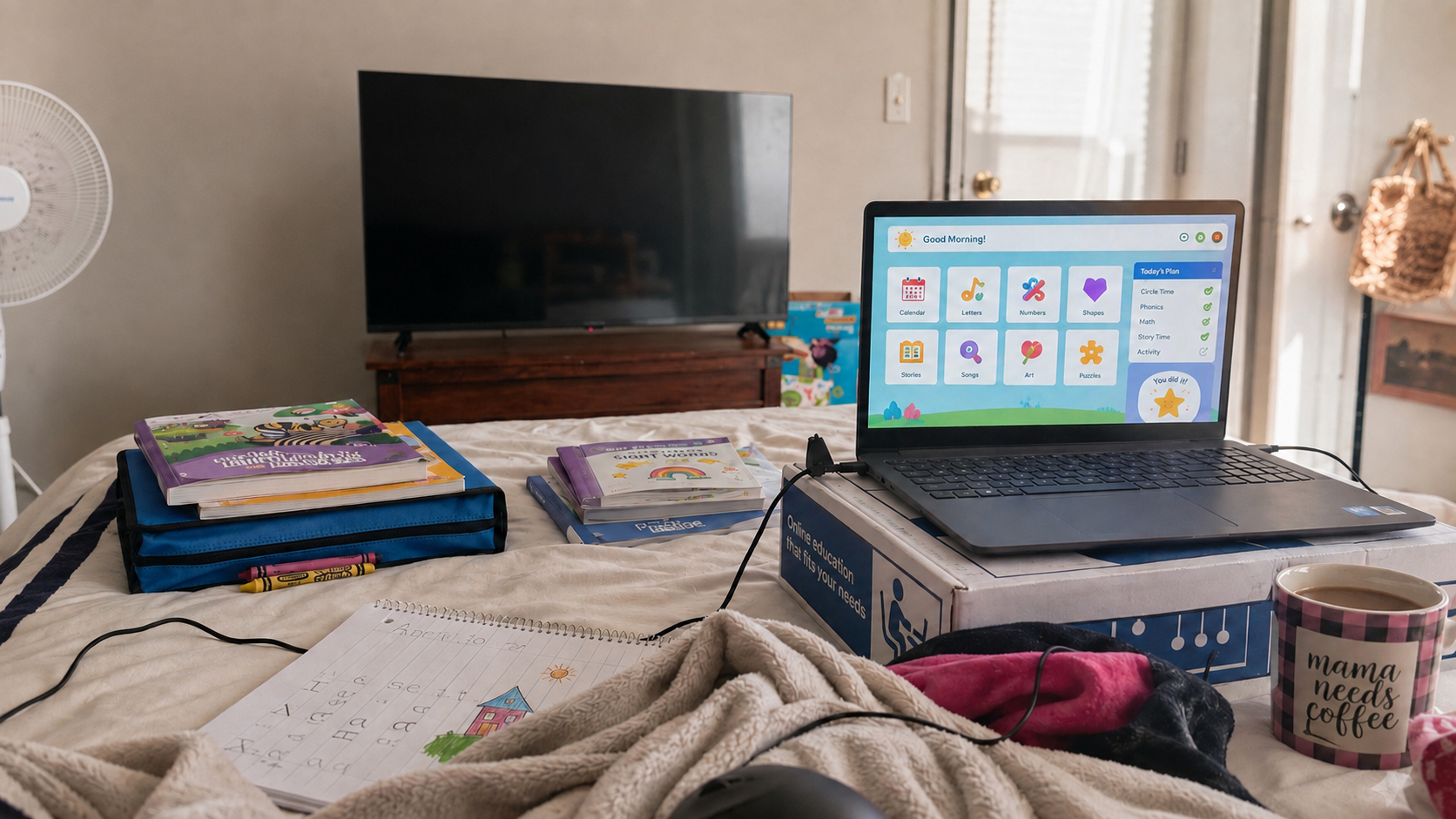
Before we started online kindergarten at home, I knew I was going to be involved. She is five, so I never expected to hand her a laptop and tell her to let me know how phonics went. I thought I would help with technology, keep her focused, and step in when needed. What I did not expect was how much of her school day would also become mine.
Online kindergarten is still real school. She has teachers, live lessons, recorded lessons, workbooks, assignments, small groups, learning programs, and a full curriculum. The difference is that, at five, she still needs an adult beside her for much of it. That adult is me, which means she enrolled in kindergarten and I somehow got pulled back in as an unpaid teaching assistant with no cafeteria privileges.
Why We Chose Online School
I know some people will wonder why we do not just send her to regular school. We have several reasons, and none of them came from believing online school would be easier. If anything, I think we chose the option where both of us get homework.
One of the biggest reasons is potty training. She is stubborn in a way that would almost be impressive if I were not the person trying to work through it with her. Despite a lot of effort, she is still not fully potty trained. That could leave her needing more personal help at school than some children her age.
We are not comfortable depending on another adult to handle that kind of private care for her. That is not an attack on teachers or school staff. Many are wonderful. We are simply careful about who helps our children with personal needs, and this is one boundary we are not willing to ignore just because regular school is the usual choice.
School safety matters too. Gun violence at schools is real, and threats have become far too common. Bomb threats, lockdowns, and school shootings are words parents hear often enough that they have become disturbingly familiar. I hate that any of those concerns have to sit beside things like crayons and letter sounds when making a kindergarten decision, but pretending they do not cross my mind would be dishonest.
Every family has different needs, and I am not suggesting that everyone should make the same choice. For us, online school gives us more control over her environment while we continue working on potty training and helping her learn. It also takes a few very real worries off the list already running in my head.
That list did not need additional hobbies.
Our School Day Starts Live
Her live school day starts at 9:00 a.m. with a one-hour class. The first fifty minutes focus on English language arts, and the last ten minutes move into math. One teacher is managing about thirty-five kindergartners, all on video, and there are times when the students are expected to turn on their microphones and answer questions.
If you have never watched one adult try to guide thirty-five five-year-olds through a live video lesson, I can confirm that everyone involved deserves some form of hazard pay. Most of the time, the teacher keeps things moving surprisingly well. Still, there are plenty of tiny faces on the screen, microphones waiting to betray somebody, and children who occasionally have information to share that has absolutely nothing to do with the lesson.
I stay nearby because she may need help finding the right screen, using a button, or understanding what she is supposed to do. The teacher is leading the class, but a five-year-old on a computer still requires local tech support. Apparently that position was filled internally.
At 10:00 a.m., she has her small-group phonics and reading lesson. That class lasts a full hour and looks very different from the larger session. There is one teacher and only six students, with everyone on video and using their microphones.
The smaller group gives her much more direct interaction with the teacher. She gets more chances to answer questions, practice sounds, work on early reading skills, and actually participate instead of being one face among thirty-five. It is still a long stretch for a five-year-old, but I can see the difference that smaller group makes.
After that, her live academic classes are finished for the day. Everything else happens through recorded lessons, workbooks, learning programs, assignments, and the hands-on work we do together.
ClassKick Turns Me Into a Tiny Production Crew
She has ClassKick assignments with several activities inside them. Some are simple, like choosing an answer or moving something on the screen. Others require her to answer out loud and submit a recording.
That means I help her find the assignment, understand what it wants, record her response, and make sure it actually submits. Naturally, she can know exactly what she wants to say until the microphone turns on. Then spoken language becomes an ancient skill lost to civilization.
Eventually, we get the answer recorded. Somewhere out there, a teacher receives twelve seconds of audio that required far more production work than twelve seconds of audio should ever require.
English Language Arts Can Eat Half the Day
English language arts includes a recorded lesson, workbook pages, handwriting, activities, and twenty minutes of Reading Eggs. Reading Eggs is one of the parts she enjoys because it turns early reading skills into games while working on letters, sounds, words, and basic reading.
If the lesson does not click, I explain it another way. We might write a letter down, repeat its sound, find things around the room that begin with it, or use completely different examples. Sometimes the lesson makes sense immediately. Other times, the concept seems to leave the building before the video even ends.
Once all the pieces are added together, English language arts can take two to two and a half hours. She is not staring at a screen that entire time. We move between activities, take breaks, work on paper, and practice together.
Still, the clock remains cruelly committed to moving forward.
Math Has Its Own Sense of Humor
Math includes a recorded lesson, workbook work, online activities, and twenty minutes of Mathseeds. Right now, she is learning shapes, patterns, numbers, counting, and written number words.
She has made progress. She can recognize numbers through ten and knows some number words, which I am genuinely proud of. What fascinates me is how much the setting changes what she understands.
She may recognize the number 1 perfectly well by itself. Put that exact same number into 1 + 1, and suddenly it has entered witness protection.
Counting past ten is still hard too, so we practice it often. Once the lesson, workbook, Mathseeds, breaks, and extra help are included, math can also take two to two and a half hours.
The phrase “math lesson” sounds much more innocent before you live it.
Phonics Is a Full Subject, Not a Side Quest
Phonics has recorded lessons, activities, and twenty minutes of Fast Phonics. She works on uppercase and lowercase letters, letter sounds, beginning sounds, middle sounds, ending sounds, and sight words.
Fast Phonics helps by turning some of that practice into games. That gives her another way to work on the same skills without everything feeling exactly the same.
Phonics can also stretch into two to two and a half hours, depending on how much extra practice she needs. By the time we finish the three main subjects, kindergarten has somehow become a full-time job without offering either of us benefits.
Noon Recess Looks a Little Different Online
At 12:00 p.m., she gets thirty minutes of recess. Obviously, nobody is sending thirty-five kindergartners onto the same virtual playground and hoping for the best. Instead, she can join a small online game room with four other students from her class.
They get to play games, talk, and socialize for half an hour. It gives her a chance to interact with classmates without a teacher actively leading a lesson or asking everyone about letter sounds.
I actually like that they built social time into the day. One of the first concerns people tend to have about learning from home is whether kids get enough chances to interact with other children. A thirty-minute virtual recess is not identical to running around a playground, but it does give her time to talk, play, laugh, and get to know classmates.
And because there are only five kids in the room, she can actually have a conversation instead of trying to socially compete with thirty-four other kindergartners and whatever microphone chaos the universe has planned for that morning.
Brain Breaks Are Doing Important Work
Her school also includes ten-minute brain breaks throughout the day. She can dance, jump, exercise, or simply move away from the screen. Those breaks count toward physical education and help both of us reset when a lesson starts getting frustrating.
Her health work fits into everyday life too. Washing hands, bathing, changing clothes, and learning basic safety all count. I appreciate any class where keeping a child alive and reasonably clean qualifies as academic progress.
Science and social studies give us some variety as well. Social studies happens on Mondays and Wednesdays, while science falls on Tuesdays and Thursdays. Those subjects usually move faster than the main classes, which is good because by then the school part of my brain is often surviving on fumes and spite.
Almost every subject also seems capable of involving crayons. At this point, I am starting to suspect construction paper has lobbyists.
Finishing the Lesson Is Not the Same as Learning It
The biggest thing I underestimated about online kindergarten is how often the lesson is only the beginning.
She can watch a recorded lesson, finish the activity, and still not understand the idea. That does not mean she was not listening or that the teacher did something wrong. She is five, and she is learning concepts adults now treat as obvious because we forgot there was once a time when numbers and letters meant absolutely nothing to us.
A recorded lesson cannot see the moment her face changes because she got lost. It also cannot always tell whether she chose the right answer because she understood it or because she guessed.
I can see that.
When she is confused, I step in. We use objects around the house, write things on paper, repeat sounds, count toys, or try another example. I do not need to repeat the whole lesson. I just need to find the part that did not connect and try to build a bridge from there.
That is why online school in our house is not simply a child sitting in front of a computer. The school provides the teachers, lessons, books, and structure. I help turn those lessons into something she can actually use.
My Health Can Change the Schedule
Because she needs so much hands-on help, my health affects her school day too.
That became very clear recently when I ended up in the hospital on a Thursday. By Friday, I was recovering and functioning somewhere between “technically awake” and “please do not ask me to process information.”
There was no realistic way I could guide her through hours of school that day, so we did not. We caught the work up on Sunday instead.
That is one of the biggest benefits of online school for us. The work still had to happen, but it did not have to happen while I was physically unable to help her well.
The tradeoff is that her schedule and mine are connected. A bad health day, long appointment, or unexpected medical problem can change when we do school. That can be frustrating, but I would rather move the work than sit beside her barely functioning and pretend either of us is learning anything useful.
Progress Does Not Always Look Impressive
The hardest part emotionally is how slow progress can feel.
We may practice a letter or sound many times before it sticks. Counting past ten is still difficult, and something she understands in one setting can become confusing in another. After enough repetition, there are moments when I start wondering whether I have explained the letter B seventeen times for personal growth.
Then I remind myself that she is building these skills for the first time. She is not reviewing something she already knows. Her brain is creating the foundation that everything else will sit on later.
That means repetition is not a sign that nothing is happening. Sometimes repetition is the progress, even before we can see the result.
The Little Breakthroughs Feel Huge
When something finally clicks, I am ridiculously proud of her. She may recognize a letter before I help, make the right sound, identify a number, or notice a pattern on her own.
From the outside, those things probably look small. I know what came before them.
I know how many times we practiced, how often she forgot, and how much work went into that one answer. I am not just watching her get something right. I am watching confusion turn into understanding.
That is one of the parts of online school I genuinely love.
It Is More Hands-On Than I Expected
Before we started, I thought I would mostly supervise. Her teachers would teach, and I would help her stay focused, use the computer, and complete assignments.
In reality, I am part tech support, tutor, teaching assistant, motivator, schedule keeper, and kindergarten audio engineer. The job description expanded without consulting me.
There are days when I feel like I have personally attended kindergarten for six hours. Realistically, I have. The main difference is that nobody sends me home with a sticker for making good choices.
The time commitment is substantial, especially when one of the main subjects takes two hours or more. Add live lessons, assignments, breaks, science or social studies, and normal five-year-old interruptions, and the day fills quickly.
Some days move smoothly. Other days, one simple concept becomes the thing we work on all afternoon. Technology also reserves the right to wake up and choose violence whenever things have been going suspiciously well.
Why We Keep Choosing It
There are days when regular school sounds much easier. I understand why someone might look at our schedule and wonder why we are doing this.
The answer is that, for us, the benefits still outweigh the work.
She can learn at home while we continue working on potty training without putting her in a situation that makes us uncomfortable. We have more control over the environment and the adults around her. School safety worries do not disappear from the world, but some of the fears that concern us are no longer part of her daily school setting.
I also get a close view of how she learns. I know which skills come easily, which ones frustrate her, and which lessons need another explanation. That takes time, but it also lets me support her in ways I might not otherwise be able to.
Most importantly, she is learning.
It may not happen on the schedule I would choose. It may involve more crayons, passwords, recordings, and repeated letter sounds than I ever imagined. My health may occasionally turn Friday school into Sunday school.
But the work gets done, and we keep moving.
That is what online kindergarten looks like in our house. It is messy, demanding, flexible, funny, frustrating, and occasionally held together by educational apps and pure stubbornness.
Right now, it works for us.
That is enough.
0 thoughts on this story